

How to Build a Successful Business Without Leaving Your Job
26 September، 2021
How to Win Sales Deals
27 September، 2021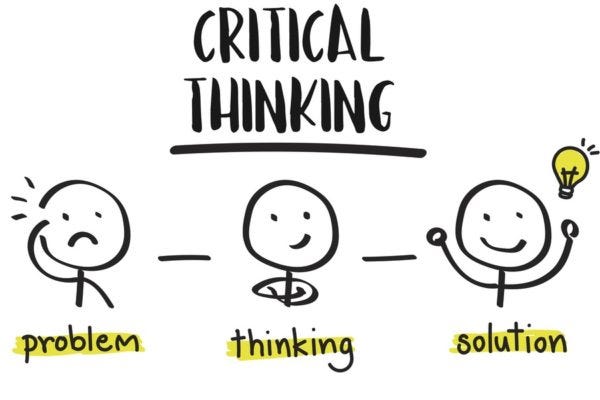
There’s no doubt that critical thinking is becoming increasingly valuable today, especially as there’s an ongoing need to develop
a critical mindset that enables you to perform at your best at work. That’s why it’s important to learn the fundamentals of
critical thinking and work to master them.
At the same time, it’s important to understand common errors in critical thinking and how to overcome them.
In this article, we’ll discuss critical thinking fallacies, how they can arise while you’re working in sales, and explain
The right way to address them, concluding with a set of important tips for improving critical thinking.
.
8 Common Critical Thinking Fallacies and How to Overcome Them
There are many critical-thinking fallacies to watch out for in your work so you can
address them effectively and achieve the best results in your interactions with customers. Here are 8 of the most common fallacies
Critical thinking and how to overcome it:
.
Fallacy 1: Generalization
One of the most common critical-thinking fallacies is making sweeping judgments when dealing with people,
or assuming that everyone behaves the same way. As a result, you may make promises you can’t actually keep, because of
your mistaken assumptions.
.
How to Overcome This Fallacy
تجنب في حديثك استخدام الكلمات التي توحي بالتعميم أو المبالغة مثل “دائماً، أبداً، الجميع، لا أحد”. بدلاً من
choose your words carefully for each person you interact with, and don’t generalize from one experience to others.
This will help you ensure that you work in the way that’s right for each person, while staying closely connected with every
buyer instead of coming across as if you’re making a generic sales pitch.
.
Fallacy 2: Black-and-White Thinking
This critical-thinking fallacy occurs when you see a situation as having only two possible options and judge
it from that perspective. For example, when speaking with a customer, you focus on one particular point and treat it as though
a specific answer from them means no other options are available. This reduces your chances of making a sale—or of even
noticing those opportunities in the first place.
.
How to Overcome This Fallacy
Rather than treating it as a simple either-or choice, it’s helpful to take a more holistic approach and examine
the different options that may be available, then include more of them during the sales process to improve the outcome. This helps
apply critical thinking to improve sales by suggesting and incorporating other ideas to increase sales or communication
مع العملاء.
.
Fallacy 3: The Causal Fallacy
This is one of the most common fallacies in critical thinking because it involves trying to solve a problem by addressing its
apparent cause rather than identifying its root cause. Ultimately, misunderstanding the customer’s needs may lead you to suggest
inappropriate solutions. You may put in a great deal of effort, only to find that the problem remains unresolved, which
This leaves the customer dissatisfied and wastes effort.
.
How to Overcome This Fallacy
Focus on using your listening skills when communicating with customers, and try to understand the root causes of the problems they
تحدث معهم. يمكنك الاعتماد على طريقة 5 why’s لمساعدتك على تحليل الأسباب الجذرية للمشكلات،
so you can make sure you provide the customer with the right solution and demonstrate the quality of your engagement and contribution to
resolving the problem they are facing.
.
Fallacy Four: The Bandwagon Fallacy
This is one of the most common fallacies in critical thinking, and it leads to many unresolved problems, unfortunately.
It stems from misinterpreting things. When you believe there’s one option that works for everyone, and that what one person is looking for
must be what everyone else is looking for too, you miss a real opportunity to reach a much larger audience.
.
How to Overcome This Fallacy
Instead, try to see each customer as an individual, separate from everyone else. Even if
their reasons are similar to those of others, the motivations behind their behavior may differ. So,
pay close attention to their requirements, meet them, and offer solutions tailored to their needs.
.
Fallacy Five: The Red Herring Fallacy
This critical-thinking fallacy is about focusing on distractions. It occurs when a customer talks about or focuses on
things other than the actual problem they’re experiencing. The problem with this fallacy is that it wastes
time and effort, and the customer may ultimately blame you for not doing what they wanted.
.
How to Overcome This Fallacy
When listening to a customer, it’s important to first try to understand their needs, rather than their wants. For example, hunger is a need, while a want
is the type of food a person prefers to eat. Critical thinking will help you identify the customer’s
primary need, so you can focus on providing the right solution instead of taking a random approach to
الحديث معه.
.
Fallacy Six: The Appeal to Familiarity
This fallacy is common in critical thinking, especially when you’re trying to introduce new things to customers. You may find that they
tend to prefer old solutions, even if they’re ineffective or better alternatives are now available.
This is because they trust what’s familiar and have grown accustomed to it. As a result, you may encounter this fallacy when
your company is an innovator introducing new solutions to customers.
.
How to Overcome This Fallacy
First, make sure you understand the fundamentals of change management and how people respond to change. This will help you understand
why change is difficult for them. Then you can discuss their assumptions and convince them of the quality of the products that
what you offer, and how you provide the ideal solution to the problems they actually face. Explain that replacing
the old with the new benefits them in terms of efficiency, quality, or time, and offer the necessary guarantees to encourage them to give it a try.
This fallacy occurs when customers lack sufficient information or make certain assumptions about
.
Fallacy Seven: The Appeal to Ignorance
your products. In either case, the result is that they are reluctant to buy. For example, some customers may tell you:
“We don’t know what this is, so we don’t need it.” What’s happening here is that customers are relying on their lack of knowledge about your product to explain their refusal to
“نحن لا نعرف ما هذا، لذا لا نحتاج إليه”. ما يحدث هنا هو اعتماد العملاء على جهلهم بمنتجك لتفسيرهم عدم
Making purchases.
.
How to Overcome This Fallacy
Be careful not to let this fallacy occur. Show respect and appreciation for what people don’t know, and recognize that their lack of knowledge may actually put them off buying.
During a sale, always focus on selling the benefits, not the product’s features. For example, don’t just say, “We sell a phone with a 100-megapixel camera.” Explain what that means for the customer and how they can benefit from it.
For example, don’t just say, “We sell a phone with a 100-megapixel camera.” Explain to the customer what
that means for them and how they can use it to capture their happy moments.
.
Fallacy Eight: The Appeal to Authority
This critical-thinking fallacy occurs frequently: you’ll hear customers say, “We don’t have the authority to make a decision”
the purchase, and we have to go back to another person, a manager, or someone else to get a decision. As a result, you find yourself unable to
continue the discussion with the person because of this.
.
How to Overcome This Fallacy
The main problem for you here is that you don’t know how truthful they’re being. Are they really unable
to make the decision, or are they trying to avoid completing the purchase? That’s why you need to study consumer
behavior carefully and understand the factors that influence purchasing decisions, including the people who influence them, so you can judge how
truthful they are. Of course, this becomes even more difficult when you’re trying to sell to businesses. It’s important to focus on
Follow up with the person again to try to close the sale, rather than giving up based on what the customer said the first time,
when they may already be a potential customer.
.
10 Tips to Strengthen Critical Thinking Skills in Sales
Alongside these fallacies, you’ll encounter many other challenges to critical thinking. So, even if you
don’t know all the fallacies, you can use critical thinking to help you achieve your goal the right way,
by following these tips.
Tip 1: Embrace a curious mindset
Don’t be quick to accept things at face value in your life. Instead, focus on looking beyond what you see,
Don’t try to ignore things you don’t know, or rush to make assumptions. Use critical thinking to investigate
the things you encounter around you thoroughly.
.
Tip 2: Rely on trusted sources
We all need sources that provide us with information, which we use to form our assumptions and ideas
about everything. One of the most important aspects of critical thinking is relying on trustworthy sources that provide you with information
that is accurate and unbiased. Don’t limit your sources to what’s easy to access or what confirms your existing beliefs. Instead,
make sure to rely on a variety of sources that offer different perspectives.
.
Tip Three: Put Yourself in Other People’s Shoes
One way to improve your critical thinking is to try to understand people’s motivations. When you know what motivates someone
to buy, you can use those motivations to help close sales. Of course, you can only learn these things
by putting yourself in other people’s shoes and trying to see things from their perspective to gain the best
understanding possible. You can then improve the marketing messages you send them and help them make a purchase decision.
منك بسهولة.
.
Tip 4: Look for the motivation
This tip builds on the previous one: every buyer has their own reasons and motivations for making a purchase. They may be
Motivations may include seeking quality, looking for a lower price, and more. When you try to understand your customer
well and learn what motivates them, you can address those motivations to close the sale.
.
Tip 5: Keep your knowledge up to date
As a sales professional, you interact with different people and have many discussions with them. Here are some
critical-thinking tips that can improve your communication with customers while also strengthening your discussion
and argumentation skills: make sure your knowledge stays up to date, and keep up with developments in your field and in
areas that interest you and are relevant to what you sell.
.
Tip 6: Learn to ask questions
Asking questions is at the heart of critical thinking. When you can ask customers the right questions, you’ll get
answers you can use to improve your professional sales pitch, and you’ll be able to overcome all
the critical thinking fallacies you might encounter. You’ll also learn everything about customers’ motivations for making a purchase.
.
Tip 7: Check Your Understanding
Don’t jump straight to conclusions when speaking with a customer, and don’t make any assumptions before making sure that you’re
on the right track. When you make an effort to verify that you understand things correctly, you’ll be able to refine
your opinions effectively, and your suggestions will offer significant value to the customer.
.
Tip 8: Break Big Tasks into Smaller Steps
One of the most important aspects of critical thinking is recognizing that things are made up of multiple parts, so they can’t be solved all at once
without first breaking the larger problem down into smaller points. Doing so will help you think carefully about each
part until you eventually see the whole picture.
.
Tip 9: Listen Carefully
Listening can help you overcome many of the pitfalls of critical thinking.
All you need to do is listen carefully to what the customer wants to say and pay attention to the information and unspoken messages
they share through their words. This will help you provide them with the right solutions.
.
Tip 10: Check Your Approach
Perhaps the most important part of critical thinking is being mindful of your approach and making sure you don’t use fallacies
with others, as they may with you. When you use the right approach to interacting with people, you’ll find
yourself achieving the results you want much more easily.
In conclusion, critical thinking is one of the most important skills for professional success. That’s why you need to focus on
continually developing this skill and paying attention to everything that happens during discussions with customers. When
you do this, your mindset will improve, and you’ll find that your critical-thinking skills get stronger, which will
Make a positive impact in your current role and in every aspect of your life.







